
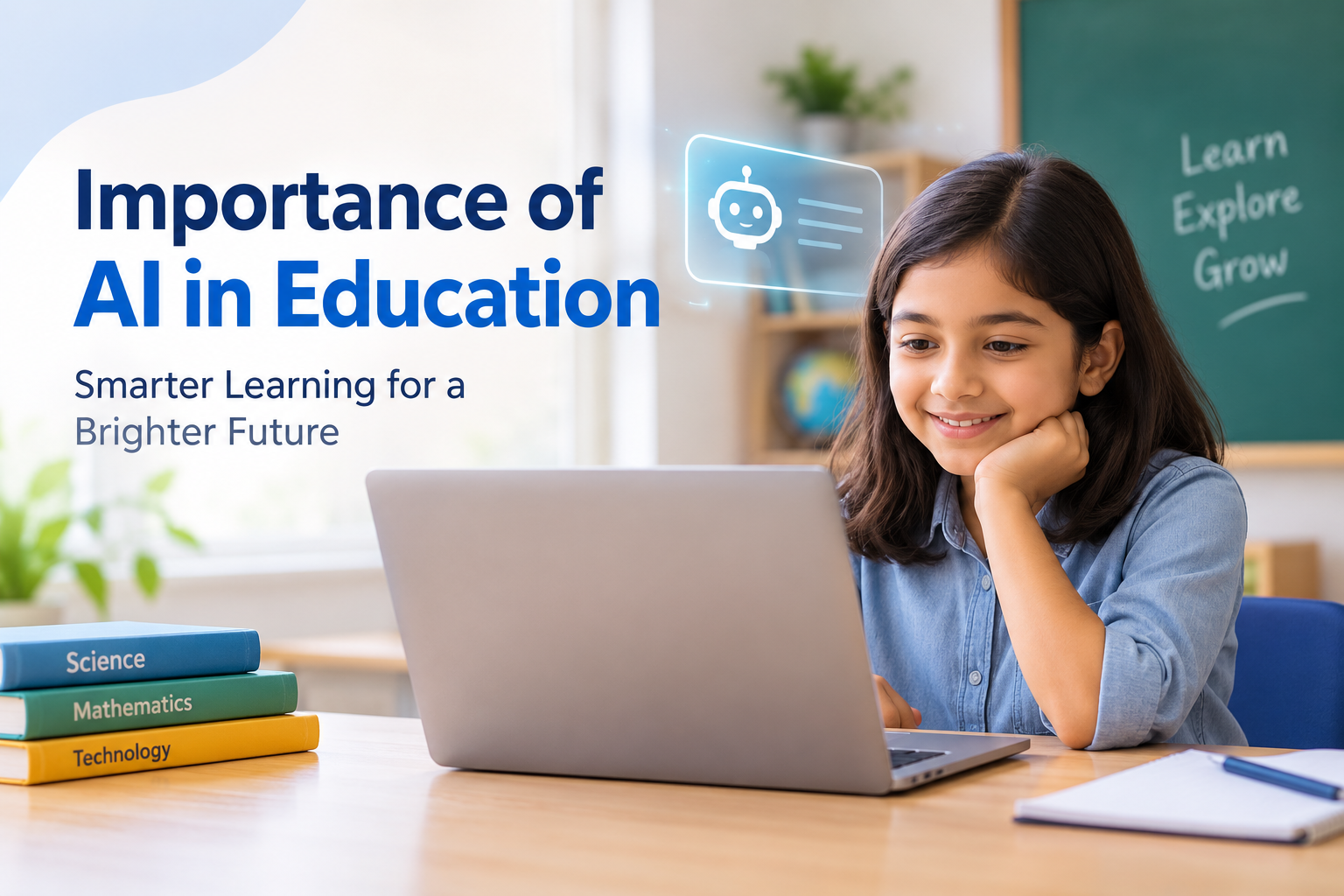
The modern era is the era of the technology. We cannot imagine the world without technology and the use of AI. AI technology is paying a vital role in every field of a human being. Imagine that every student learns in a way that feels natural to them with a help from technology. Artificial Intelligence or AI is changing education. Making learning more interactive easier to reach and personal. At Indirapuram Public School, Pratap Vihar, we works hard to students for a future that is guided by technology, innovation and creativity.
What is AI in Education?
Artificial intelligence means technology that can look at data find patterns and give answers. AI learning apps, educational chat bots and quizzes that adapt help students practice ideas and give them feedback. For example a learning app can suggest math practice when it sees a students answers. When AI tools are used wisely AI can make learning more engaging and effective.
5 Benefits of AI in Education
AI has benefits for students and teachers:
• Personalised Learning: AI helps students learn at their pace and with appropriate exercises and explanations.
• Better Student Engagement: games, interactive activities and virtual experiments make learning interesting.
• Support for Teachers: AI helps teachers create lesson plans, worksheets and tests giving teachers time for real class work.
• Identifying Learning Gaps: Digital tools can spot areas where students need help.
• Future-Ready Skills: AI learning builds thinking, creativity, problem solving and digital understanding.
AI Education in Schools: Learning Beyond Classrooms
To improve student understanding of technologies Indirapuram Public School, Pratap Vihar has built a Robotics Lab. The lab gives chances for hands‑on learning letting students explore robots learn programming ideas and find real uses of AI. These activities spark curiosity, teamwork, testing and creative thinking.
Students learn how robots obey instructions how sensors collect data and how programmed systems react to situations. These experiences link classroom ideas to world use.
Computer scientist Andrew Ng, an AI researcher and teacher often points out AIs powerful potential. His work shows how AI can solve problems and improve parts of daily life.
AI Education and the CBSE Curriculum 2026–27
AI knowledge is growing more vital in schools. In April 2026 CBSE brought a plan for Computational Thinking and Artificial Intelligence for Classes III to VIII for the 2026 to 2027 school year. The plan emphasizes thinking, pattern spotting, problem solving, digital skills and careful use of tech. This change shows that it is more important for students to understand technology than just to use it. Robotics activities and guided projects can support these learning aims.
Challenges and Responsible Use of AI
Even though AI has benefits AI must be used carefully. Students should check facts keep data safe and avoid copying AI answers. Students should also know that AI can sometimes give unfair information.
UNESCO guidance on AI in education stresses a human‑focused method, where tech helps teachers and learners and keeps privacy, fairness and human judgment safe. Teachers and parents therefore must build digital habits and support independent thinking.
Role of Parents in Developing AI Literacy in Children
Parents can ready children for AI learning by showing age‑right AI ideas and encouraging curiosity about how tech works. Parents must watch AI tool use talk about safety and remind children to check facts instead of accepting every answer. Simple tasks like pattern spotting, logic puzzles and coded lessons can grow problem‑solving and logical skills. Parents should also ask children to explain what they learned in their words, which builds confidence, creativity and independent thought.
Preparing Children for an AI-Powered Future
At Indirapuram Public School, Pratap Vihar, we believe that learning becomes more interesting when good teaching is combined with modern technology. Our Robotics Lab gives students an opportunity to explore new ideas, ask questions, try things out and learn through experience. It helps them develop creativity, curiosity and problem-solving skills, preparing them to face the challenges of the future.
I would like to share a simple thought with our students: The future belongs to those who think wisely, come up with new ideas and use technology responsibly. AI can make learning easier and more interesting, but it can never replace teachers, human relationships or learning through practical experiences. With the right guidance and opportunities, students can learn to use AI wisely, solve problems creatively and become responsible digital citizens who continue learning throughout their lives.
अनेकसंशयोच्छेदि परोक्षार्थस्य दर्शकम् । सर्वस्य लोचनं शास्त्रं यस्य नास्त्यन्ध एव सः ॥
Shastra, which means science, instruction or knowledge cuts through all doubts and reveals hidden or unseen things. Shastra is the eye, for everyone. Anyone who lacks Shastra is essentially blind.